THE COMPLETE GUIDE TO .243 WINCHESTER AMMUNITION IN THE USA


Few cartridges in American firearms history have achieved the kind of universal
acclaim that the .243 Winchester enjoys today. Celebrated by deer hunters in the
deep woods of Pennsylvania, prairie dog shooters on the open plains of Wyoming,
and competitive long-range marksmen across the country, the .243 Winchester has
carved out a permanent and beloved niche in the landscape of American shooting
culture. You can buy the .243 Winchester Ammo in stock from Target Ammo Store USA
What makes the .243 Winchester so special? The answer lies in its extraordinary
versatility. It is powerful enough to cleanly and ethically harvest deer, pronghorn,
and black bear, yet flat-shooting and accurate enough to reach out across hundreds
of yards to take varmints the size of a ground squirrel. The recoil is mild enough
to be handled comfortably by youth shooters and recoil-sensitive adults, yet the
ballistics are impressive enough to satisfy the most demanding experienced hunter.

In the United States, the .243 Winchester is not merely a cartridge — it is an
institution. It has been the "first deer rifle" cartridge for millions of American
hunters over the past seven decades. It has introduced countless young shooters to
the sport of centerfire rifle hunting and target shooting. And it remains, to this
day, one of the top-selling rifle cartridges in the country.
This blog takes a comprehensive look at everything there is to know about .243
Winchester ammunition in the USA — from its fascinating origins to modern-day
market trends, from terminal ballistics to legal considerations, and from factory
loads to the art of handloading. Whether you are a seasoned hunter, a new shooter,
or simply curious about this legendary round, this guide is for you.
================================================================================
SECTION 2 — HISTORY AND ORIGINS OF THE .243 WINCHESTER
================================================================================
THE BIRTH OF A LEGEND (1955)
The .243 Winchester was introduced by Winchester Repeating Arms Company in 1955,
chambered in the Model 70 bolt-action rifle and the Model 88 lever-action rifle.
Its introduction was a direct response to the growing popularity of the .257
Roberts and the .220 Swift among American hunters and varmint shooters who were
looking for a dual-purpose cartridge.
The cartridge was developed by necking down the .308 Winchester case — one of the
most successful military and sporting cartridges ever made — to accept a .243-inch
(6mm) diameter bullet. This relatively simple modification produced a cartridge with
remarkable characteristics: high velocity, flat trajectory, and low recoil, all
built on a proven, reliable parent case.
THE GUNWRITER INFLUENCE
Much of the .243 Winchester's early success can be attributed to influential American
gunwriters of the era, most notably Warren Page, the shooting editor of Field &
Stream magazine. Page had championed the 6mm bore diameter for years and was one
of the most vocal advocates for what would become the .243 Winchester. His writing
reached millions of American hunters and shooters and helped generate enormous
enthusiasm for the new cartridge.
Simultaneously, Remington introduced its own 6mm offering — the .244 Remington —
in the same year. The two cartridges were remarkably similar in performance, yet
the .243 Winchester quickly won the commercial battle for reasons both technical
and marketing-related. Winchester wisely offered their Model 70 with a 1:10 twist
barrel, which could stabilize heavier 100-grain bullets suitable for deer hunting,
while Remington's original 1:12 twist barrels favored lighter, faster varmint bullets.
Hunters who wanted a cartridge that could do double duty — varmints and deer — chose
the .243 Winchester in droves.
GROWTH THROUGH THE DECADES
Through the 1960s and 1970s, the .243 Winchester Ammunition became one of the most popular
deer hunting cartridges in the eastern United States, particularly valued in states
like Virginia, West Virginia, Kentucky, and Tennessee, where shots in the woods
tended to be at moderate distances.
The 1980s and 1990s saw the cartridge cement its reputation as an ideal youth deer
rifle round. Its mild recoil (approximately 8-9 ft-lbs at the muzzle for typical
loads) made it the go-to recommendation for introducing young hunters to big game
hunting. Firearms manufacturers responded by chambering youth-sized and lightweight
rifles in .243 Winchester, further expanding its appeal.
By the 2000s, the .243 Winchester had evolved alongside advancements in bullet
technology. The introduction of high-performance bonded bullets, polymer-tipped
hunting bullets, and ultra-low-drag projectiles transformed what was already a
capable cartridge into an even more formidable performer across a wider range of
applications.
Today, the .243 Winchester remains one of the top five best-selling centerfire rifle
cartridges in the United States, a testament to its enduring excellence and appeal.
================================================================================
SECTION 3 — BALLISTICS AND TECHNICAL SPECIFICATIONS
================================================================================
CASE SPECIFICATIONS
Parent Case: .308 Winchester
Bullet Diameter: .243 inches (6.17 mm)
Neck Diameter: .276 inches
Shoulder Diameter: .454 inches
Base Diameter: .471 inches
Case Length: 2.045 inches
Overall Length: 2.710 inches
Primer Size: Large Rifle
Maximum Pressure: 60,000 PSI (SAAMI)
PERFORMANCE OVERVIEW
The .243 Winchester is capable of propelling bullets ranging from 55 grains to
115 grains, though the most common hunting and sporting loads fall between 75 and
105 grains. Here is a look at representative ballistic data across the common
bullet weight spectrum:
┌──────────────┬──────────────┬──────────────┬──────────────┬────────────┐
│ Bullet Wt. │ Muzzle Vel. │ Muzzle Energy│ 300yd Vel. │ 300yd Drop │
│ (grains) │ (fps) │ (ft-lbs) │ (fps) │ (inches) │
├──────────────┼──────────────┼──────────────┼──────────────┼────────────┤
│ 55 gr │ 3,910 fps │ 1,867 ft-lbs │ ~2,900 fps │ -4.8" │
│ 70 gr │ 3,400 fps │ 1,797 ft-lbs │ ~2,600 fps │ -5.5" │
│ 80 gr │ 3,350 fps │ 1,994 ft-lbs │ ~2,580 fps │ -5.2" │
│ 95 gr │ 3,025 fps │ 1,930 ft-lbs │ ~2,400 fps │ -6.8" │
│ 100 gr │ 2,960 fps │ 1,945 ft-lbs │ ~2,380 fps │ -7.1" │
│ 105 gr │ 2,920 fps │ 1,987 ft-lbs │ ~2,360 fps │ -7.4" │
└──────────────┴──────────────┴──────────────┴──────────────┴────────────┘
The .243 Winchester's most common hunting application in America is whitetail deer
hunting. This is the role it was originally designed to fulfill, and it performs
the job admirably when used responsibly.
The consensus among experienced hunters and ballistics experts is that the .243
Winchester is effective for whitetail deer within 200–300 yards with appropriate
bullet selection and shot placement. The key considerations are:
BULLET SELECTION: A premium hunting bullet of 90–100 grains is strongly
recommended for deer hunting. Varmint bullets (55–70 gr) should NOT be used
for deer as they may cause superficial wounds without adequate penetration.
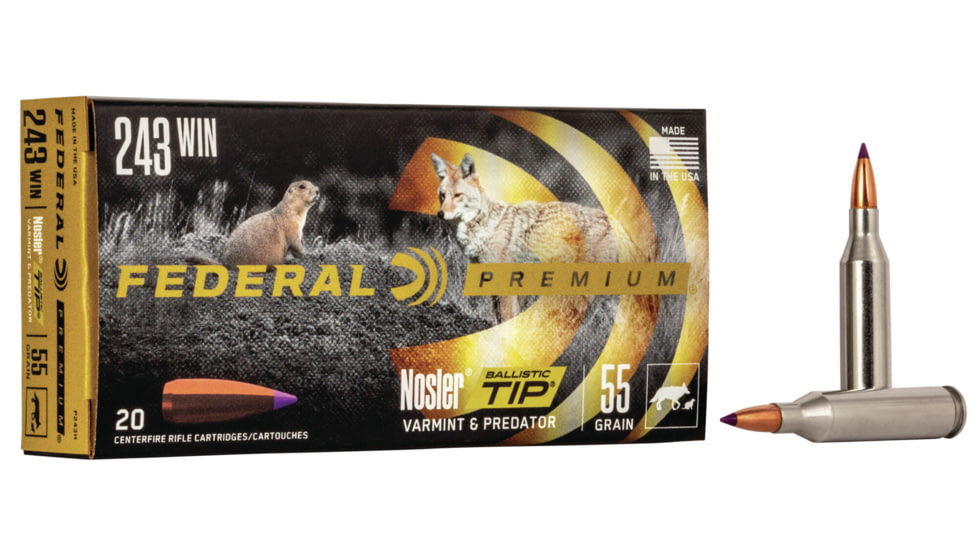
SHOT PLACEMENT: As with all deer cartridges, precise shot placement is essential.
Lung and heart shots are recommended. The .243 Winchester Ammo For Sale may lack the energy
reserves for marginal shots that larger calibers handle more forgivingly.
RANGE: The .243 Winchester retains approximately 1,000 ft-lbs of energy at
around 400 yards with a 100-grain load — a figure many ballistics authorities
cite as the minimum for ethical deer hunting. Within 300 yards, the cartridge
is entirely adequate for whitetail deer.
CONTROVERSY: Some hunters and state wildlife agencies have historically
questioned whether .243 Winchester is adequate for deer. Some states (discussed
in Section 13) have minimum caliber requirements that the .243 Winchester must
meet. Used properly with quality ammunition, it is a capable deer round. Used
carelessly with varmint bullets or at extreme ranges, it can cause wounded deer.